Matlab Code for Rice Leaf Disease Detection using Image Processing

ABSTRACT
            Agriculture is the main backbone for most of the developing/developed countries; agriculture production itself is the main feed for ever growing populations and it is the major source of income for the rural people/farmers especially in India. In India farmers are called “the backbone of India”. The main aim of the proposed system is to detect and classify the diseases in Rice leafs. Rice Diseases Classification comprises of two steps: first one is Detection, Extraction and Segmentation of diseases. Secondly, Feature extraction, Classification level of disease by using Support Vector Machine (SVM) classifiers respectively. The proposed system has been experimentally tested for our own dataset and results achieved are encouraging.

PROJECT OUTPUT

PROJECT VIDEO

Contact:
Mr. Roshan P. Helonde
Mobile: +91-7276355704
WhatsApp: +91-7276355704
Email: roshanphelonde@rediffmail.com
Share:

Matlab code for Blood Group Detection using Neural Network

ABSTRACT
           Determining of blood types is very important during emergency situation before administering a blood transfusion. Presently, these tests are performed manually by technicians, which can lead to human errors. Determination of the blood types in a short period of time and without human errors is very much essential. A method is developed based on processing of images acquired during the slide test. The image processing techniques such as Pre-processing, Segmentation, Thresholding, Morphological operations and Neural Network  are used. The images of the slide test are obtained from the pathological laboratory are processed and the occurrence of agglutination are evaluated. Thus the developed automated method determines the blood type using image processing techniques. The developed method is useful in emergency situation to determine the blood group without human error. The slide test consists of the mixture of one drop of blood and one drop of reagent, being the result interpreted according to the occurrence or not of agglutination. The combination of the occurrence and non occurrence of the agglutination determines the blood type of the patient. 

PROJECT OUTPUT

PROJECT VIDEO
Contact:
Mr. Roshan P. Helonde
Mobile: +91-7276355704
WhatsApp: +91-7276355704
Email: roshanphelonde@rediffmail.com

Share:

Hand Bone Fracture Detection using Image Processing Matlab Project with source Code

ABSTRACT
            Analysis of medical images plays a very important role in clinical decision making. For a long time it has required extensive involvement of a human expert. However, recent progress in data mining techniques, especially in machine learning, allows for creating decision models and support systems that help to automatise this task and provide clinicians with patient-specific therapeutic and diagnostic suggestions. In this project, we describe a study aimed at building a decision model (a classifier) that would predict the type of treatment (surgical vs. non-surgical) for patients with bone fractures based on their X-ray images. We consider two types of features extracted from images (structural and textural) and used them to construct multiple classifiers that are later evaluated in a computational experiment. Structural features are computed by applying the Hough transform, while textural information is obtained from Gray-level occurrence matrix. In research reported by other authors structural and textural features were typically considered separately. Our findings show that while structural features have better predictive capabilities, they can benefit from combining them with textural ones.

PROJECT OUTPUT

PROJECT VIDEO

Contact:
Mr. Roshan P. Helonde
Mobile: +91-7276355704
WhatsApp: +91-7276355704
Email: roshanphelonde@rediffmail.com
Share:

Breast Cancer Detection using Neural Network Matlab Project Code

ABSTRACT
            The World Health Organization's International agency for Research on Cancer in Lyon, France, estimates that more than 150 000 women worldwide die of breast cancer each year. The breast cancer is one among the top three cancers in American women. In United States, the American Cancer Society estimates that, 215 990 new cases of breast carcinoma has been diagnosed, in 2004. It is the leading cause of death due to cancer in women under the age of 65 . In India, breast cancer accounts for 23% of all the female cancers followed by cervical cancers (17.5%) in metropolitan cities such as Mumbai, Calcutta, and Bangalore. However, cervical cancer is still number one in rural India. Although the incidence is lower in India than in the developed countries, the burden of breast cancer in India is alarming. Organ chlorines are considered a possible cause for hormone-dependent cancers . Detection of early and subtle signs of breast cancer requires high-quality images and skilled mammographic interpretation. In order to detect early onset of cancers in breast screening, it is essential to have high-quality images. Radiologists reading mammograms should be trained in the recognition of the signs of early onset of, which may be subtle and may not show typical malignant features. Mammography screening programs have shown to be effective in decreasing breast cancer mortality through the detection and treatment of early onset of breast cancers.
          Emotional disturbances are known to occur in patient's suffering from malignant diseases even after treatment. This is mainly because of a fear of death, which modifies Quality Of Life (QOL). Desai et al.,reported an immuno histo chemical analysis of steroid receptor status in 798 cases of breast tumors encountered in Indian patients, suggests that breast cancer seen in the Indian population may be biologically different from that encountered in western practice. Most imaging studies and biopsies of the breast are conducted using mammography or ultrasound, in some cases, magnetic resonance (MR) imaging . Although by now some progress has been achieved, there are still remaining challenges and directions for future research such as developing better enhancement and segmentation algorithms. 

PROJECT OUTPUT

PROJECT VIDEO

Contact: 
Mr. Roshan P. Helonde 
Mobile: +91-7276355704 
WhatsApp: +91-7276355704 
Email: roshanphelonde@rediffmail.com
Share:

Audio Steganography (Hiding Secrete Information in Audio) Matlab Project Code

ABSTRACT
           Today’s large demand of internet applications requires data to be transmitted in a secure manner. Data transmission in public communication system is not secure because of interception and improper manipulation by eavesdropper. So the attractive solution for this problem is Steganography, which is the art and science of writing hidden messages in such a way that no one, apart from the sender and intend recipient, suspects the existence of the message, a form of security through obscurity. Audio steganography is the scheme of hiding the existence of secret information by concealing it into another medium such as audio file. The steganography application hides different types of data within a cover file. The resulting stego also contains hidden information, although it is virtually identical to the cover file.

PROJECT OUTPUT

PROJECT VIDEO

Contact:
Mr. Roshan P. Helonde
Mobile: +91-7276355704
WhatsApp: +91-7276355704
Email: roshanphelonde@rediffmail.com
Share:

Matlab code for Brain Tumor Detection using Convolutional Neural Network (CNN)

ABSTRACT
           Brain tumor identification is really challenging task in early stages of life. But now it became advanced with various machine learning algorithms. Now a day’s issue of brain tumor automatic identification is of great interest. In Order to detect the brain tumor of a patient we consider the data of patients like MRI images of a patient’s brain. Here our problem is to identify whether tumor is present in patients brain or not. It is very important to detect the tumors at starting level for a healthy life of a patient. There are many literatures on detecting these kinds of brain tumors and improving the detection accuracies. In this project, we Estimate the brain tumor severity using Convolutional Neural Network algorithm which gives us accurate results.

PROJECT OUTPUT

PROJECT VIDEO

Contact:
Mr. Roshan P. Helonde
Mobile: +91-7276355704
WhatsApp: +91-7276355704
Email: roshanphelonde@rediffmail.com
Share:

Image Fusion using Wavelet Transform Matlab Source code

ABSTRACT
            Different medical imaging techniques such as X-rays, computed tomography (CT), magnetic resonance imaging (MRI), and positron emission tomography (PET) provide different perspectives for the human body that are important in the physical disorders or diagnosis of diseases .To derive useful information from multimodality medical image data medical image fusion has been used. In the medical field different radiometric scanning techniques can be used to evaluate and examine the inner parts of the body. The idea is to improve the image content by fusing images like computer tomography (CT) and magnetic resonance imaging (MRI) images, so as to provide as much details as possible for the sake of diagnosis. The objective of image fusion is to merge information from multiple images of the same image. The resultant image after image fusion is more suitable for human and machine perception and further helpful for image-processing tasks such as segmentation, feature extraction and object recognition. This paper mainly presents image fusion using wavelet method for multispectral data and high-resolution data conveniently, quickly and accurately in MATLAB. Wavelet toolbox with abundant functions, provide a quick and convenient platform to improve image visibility. The work covers the selection of wavelet function, the use of wavelet based fusion algorithms on CT and MRI medical images, implementation of fusion rules and the fusion image quality evaluation. Matlab Results show that effectiveness of Image Fusion with Wavelet Transform on preserving the feature information for the test images.

PROJECT OUTPUT

PROJECT VIDEO

Contact:
Mr. Roshan P. Helonde
Mobile: +91-7276355704
WhatsApp: +91-7276355704
Email: roshanphelonde@rediffmail.com
Share:

Handwritten Digit Recognition using Neural Network Matlab Source code

ABSTRACT
           Handwriting recognition is one of the compelling research works going on because every individual in this world has their own style of writing. It is the capability of the computer to identify and understand handwritten digits automatically. Because of the progress in the field of science and technology, everything is being digitalised to reduce human effort. Hence, there comes a need for handwritten digit recognition in many real-time applications. Many Machine Learning and Deep Learning Algorithms are developed which can be used for this digit classification. This project performs Digit Recognition and the analysis of accuracy of algorithms Neural Network.

PROJECT OUTPUT

PROJECT VIDEO

Contact:
Mr. Roshan P. Helonde
Mobile: +91-7276355704
WhatsApp: +91-7276355704
Email: roshanphelonde@rediffmail.com
Share:

Image Fusion using Wavelet Transform and PCA Matlab Source code

ABSTRACT
            Different medical imaging techniques such as X-rays, computed tomography (CT), magnetic resonance imaging (MRI) provide different perspectives for the human body that are important in the physical disorders or diagnosis of diseases .To derive useful information from multimodality medical image data medical image fusion has been used. In the medical field different radiometric scanning techniques can be used to evaluate and examine the inner parts of the body. The idea is to improve the image content by fusing images like computer tomography (CT) and magnetic resonance imaging (MRI) images, so as to provide as much details as possible for the sake of diagnosis. The objective of image fusion is to merge information from multiple images of the same image. The resultant image after image fusion is more suitable for human and machine perception and further helpful for image-processing tasks such as segmentation, feature extraction and object recognition. This project mainly presents image fusion using wavelet method for multispectral data and high-resolution data conveniently, quickly and accurately in MATLAB. Wavelet toolbox with abundant functions, provide a quick and convenient platform to improve image visibility. The work covers the selection of wavelet function, the use of wavelet based fusion algorithms on CT and MRI medical images, implementation of fusion rules and the fusion image quality evaluation. Matlab Results show that effectiveness of Image Fusion with Wavelet Transform on preserving the feature information for the test images.

PROJECT OUTPUT

PROJECT VIDEO

Contact:
Mr. Roshan P. Helonde
Mobile: +91-7276355704
WhatsApp: +91-7276355704
Email: roshanphelonde@rediffmail.com
Share:

Image Enhancement using Histogram Equalization Matlab Source code

ABSTRACT
             Digital image enhancement is one of the most important image processing technology which is necessary to improve the visual appearance of the image or to provide a better transform representation for future automated image processing such as image analysis, detection, segmentation and recognition. Many images have very low dynamic range of the intensity values due to insufficient illumination and therefore need to be processed before being displayed. Large number of techniques have focused on the enhancement of gray level images in the spatial domain. These methods include histogram equalization, gamma correction, high pass filtering, low pass filtering, homomorphic filtering, etc. Image enhancement techniques are of particular interest in photography, satellite imagery, medical applications and display devices. Producing visually natural is required for many important areas such as vision, remote sensing, dynamic scene analysis, autonomous navigation, and biomedical image analysis.

PROJECT OUTPUT

PROJECT VIDEO

Contact:
Mr. Roshan P. Helonde
Mobile: +91-7276355704
WhatsApp: +91-7276355704
Email: roshanphelonde@rediffmail.com
Share:

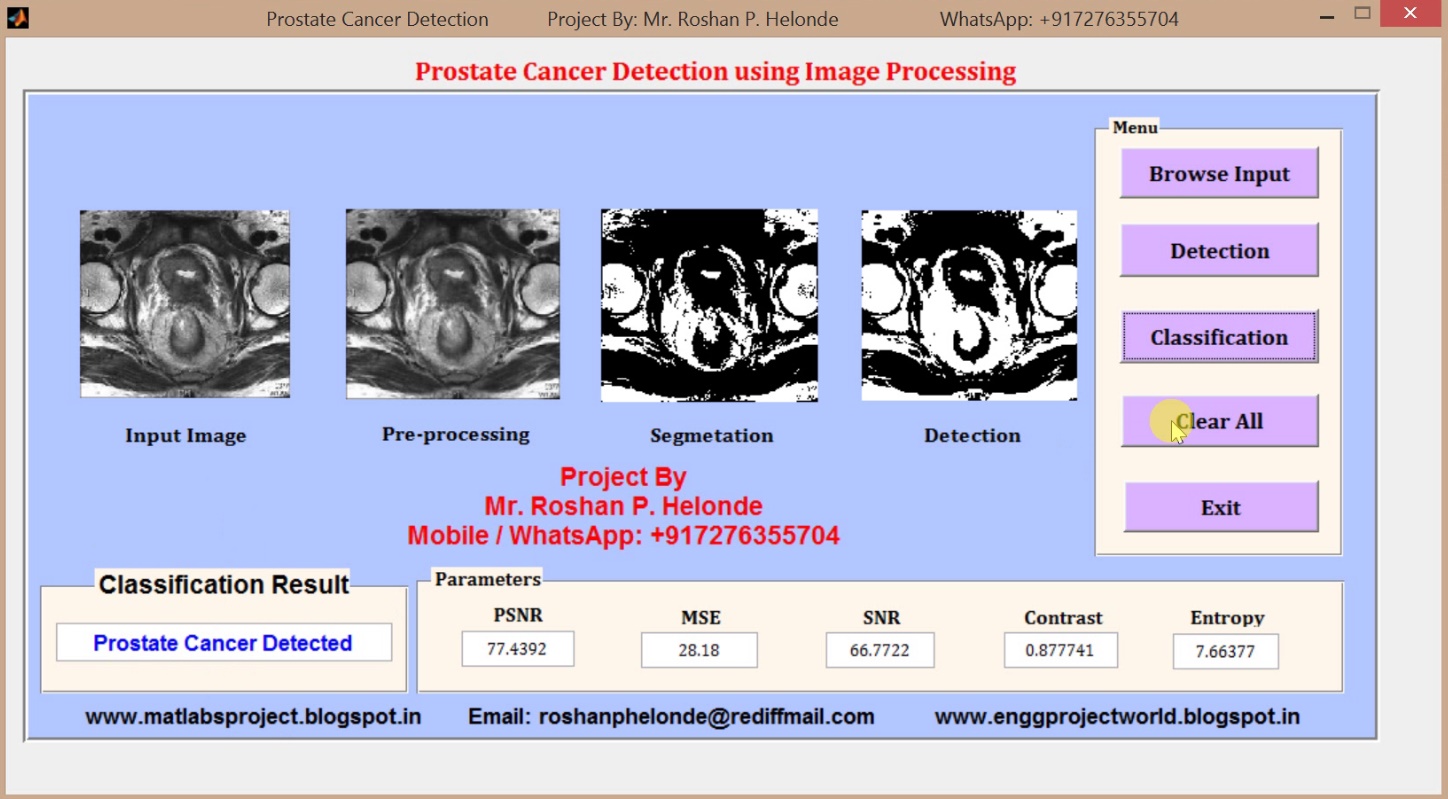
Prostate Cancer Detection using Image Processing Matlab Source Code

ABSTRACT
          This project gives an overview of the method of detecting prostate cancer by associating Region of interest segmentation method with Support Vector Machine. Prostate cancer is commonly prevalent carcinoma detected in most of the male population. A diagnosis of prostate cancer was complicated due to unclear symptoms and involves many procedures. One of these procedures involves the study of prostate tissue biopsy to find cancer affected region. However, no boundary specified region was considered for further studies. Recent developmental techniques in the medical imaging field, especially in SVM, have paved the way for prostate carcinoma detection. The MRI image of the prostate gland is pre-processed to reduce noise effects and Region of interest is obtained with the svm and segmentation is done. The core idea of this project is to assume that every region of prostate tissue could be related to malignant or unnatural tissues.

PROJECT OUTPUT

PROJECT VIDEO

Contact:
Mr. Roshan P. Helonde
Mobile: +91-7276355704
WhatsApp: +91-7276355704
Email: roshanphelonde@rediffmail.com
Share:

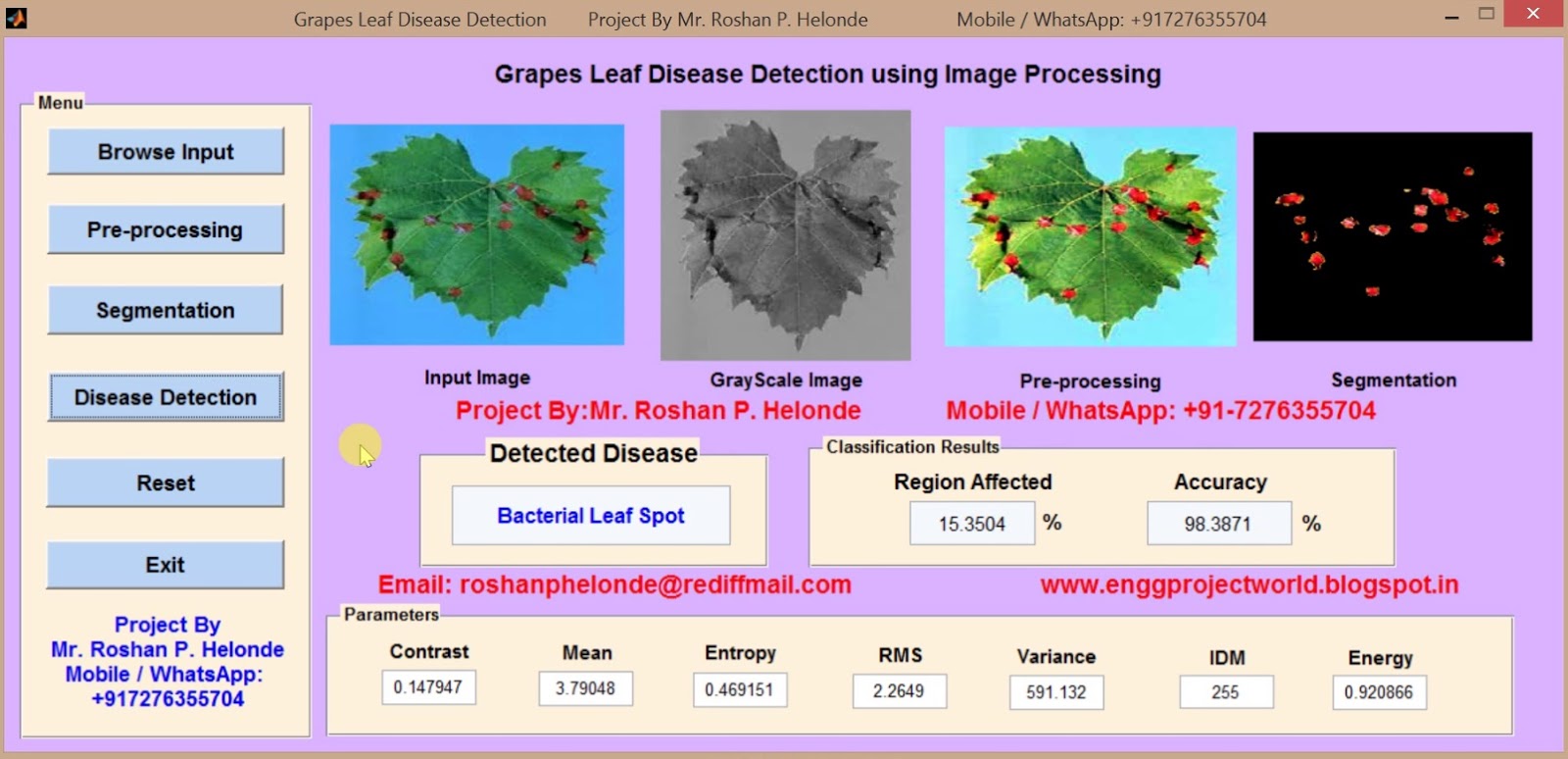
Grape Leaf Disease Detection using Image Processing Matlab Source code

ABSTRACT
             Identification of the grape leaf disease is the main goal to prevent the losses and quality of agricultural product. In India grape fruit crop is widely grown. So disease detection and classification of grape leaf is very critical for sustainable agriculture. It’s not possible to farmer, to monitor continuously the grape disease manually. It requires the excessive processing time, tremendous amount of work, and some expertise in the grape leaf diseases. To detect and classify the grape disease we need fast automatic process so we use SVM classifier technique. This project presents mainly five stages, viz image acquisition, pre-processing, segmentation GLCM feature extraction and SVM classification. This project is proposed to benefit in the detection and classification of grape leaf disease using support vector machine (SVM) classifier.

PROJECT OUTPUT

PROJECT VIDEO

Contact:
Mr. Roshan P. Helonde
Mobile: +91-7276355704
WhatsApp: +91-7276355704
Email: roshanphelonde@rediffmail.com
Share:

Early Brain Tumor Detection using Image Processing Matlab Project Code

ABSTRACT
            A tumor is a mass of tissues that is formed by an accumulation of abnormal cells. Normally, the cells in our body grow, age, die, and are replaced by new cells but the cancer and other tumors damage this cycle. The tumor cells do grow, even if the body does not want them and unlike old cells, these cells do not die easily causing tumor or cancer. The brain is the interior most part of the central nervous system and is an intracranial solid neoplasm. Tumors are created by an abnormal and uncontrollable cell division in the brain. The axial view of the brain image scan has been used. The study of brain tumor is important as it is occurring in many people. In this project, an image segmentation method was proposed for the identification or detection of tumor from the brain. The methodology consists of the following steps: pre-processing by using grey-level, sharpening and median filters; segmentation of the image was performed by thresholding and also by applying the watershed segmentation. Finally the tumor region was obtained with its area and stage of cancer.

PROJECT OUTPUT

PROJECT VIDEO

Contact:
Mr. Roshan P. Helonde
Mobile: +91-7276355704
WhatsApp: +91-7276355704
Email: roshanphelonde@rediffmail.com

Share:

Haze Removal using Image Processing Matlab Project with Source Code

ABSTRACT
           Haze causes problems in various computer vision and image processing based applications as it diminishes the scene's visibility. The air light and attenuation are two main phenomena responsible for haze formation .The air light enhance the whiteness in the scene and contrast get reduced by attenuation. Haze removal techniques helps in recovering the contrast and color of the scene. These techniques have found many applications in the area of image processing such as consumer electronics, object detection, outdoor surveillance etc. 

PROJECT OUTPUT

PROJECT VIDEO

Contact:
Mr. Roshan P. Helonde
Mobile: +91-7276355704
WhatsApp: +91-7276355704
Email: roshanphelonde@rediffmail.com
Share:

Matlab code for Image Fusion using Wavelet Transform

ABSTRACT
            Different medical imaging techniques such as X-rays, computed tomography (CT), magnetic resonance imaging (MRI), and positron emission tomography (PET) provide different perspectives for the human body that are important in the physical disorders or diagnosis of diseases .To derive useful information from multimodality medical image data medical image fusion has been used. In the medical field different radiometric scanning techniques can be used to evaluate and examine the inner parts of the body. The idea is to improve the image content by fusing images like computer tomography (CT) and magnetic resonance imaging (MRI) images, so as to provide as much details as possible for the sake of diagnosis. The objective of image fusion is to merge information from multiple images of the same image. The resultant image after image fusion is more suitable for human and machine perception and further helpful for image-processing tasks such as segmentation, feature extraction and object recognition. This paper mainly presents image fusion using wavelet method for multispectral data and high-resolution data conveniently, quickly and accurately in MATLAB. Wavelet toolbox with abundant functions, provide a quick and convenient platform to improve image visibility. The work covers the selection of wavelet function, the use of wavelet based fusion algorithms on CT and MRI medical images, implementation of fusion rules and the fusion image quality evaluation. Matlab Results show that effectiveness of Image Fusion with Wavelet Transform on preserving the feature information for the test images.

PROJECT OUTPUT

PROJECT VIDEO

Contact:
Mr. Roshan P. Helonde
Mobile: +91-7276355704
WhatsApp: +91-7276355704
Email: roshanphelonde@rediffmail.com
Share:

Facial Expression Emotion Recognition using Matlab Project with Source Code

ABSTRACT
            This project objective is to introduce needs and applications of facial expression recognition. Between Verbal & Non-Verbal form of communication facial expression is form of non-verbal communication but it plays pivotal role. It express human perspective or filling & his or her mental situation. A big research has been addressed to enhance Human Computer Interaction (HCI) over two decades. This project includes introduction of facial emotion recognition system, Application, comparative study of popular face expression recognition techniques & phases of automatic facial expression recognition system. Emotional aspects have huge impact on Social intelligence like communication understanding, decision making and also helps in understanding behavioral aspect of human. Emotion play pivotal role during communication. Emotion recognition is carried out in diverse way, it may be verbal or non-verbal .Voice (Audible) is verbal form of communication & Facial expression, action, body postures and gesture is non-verbal form of communication. While communicating only 7% effect of message is contributes by verbal part as a whole, 38% by vocal part and 55% effect of the speaker’s message is contributed by facial expression. For that reason automated & real time facial expression would play important role in human and machine interaction. Facial expression recognition would be useful from human facilities to clinical practices. Analysis of facial expression plays fundamental roles for applications which are based on emotion recognition like Human Computer Interaction (HCI), Social Robot, Animation, Alert System & Pain monitoring for patients.

PROJECT OUTPUT

PROJECT VIDEO

Contact:
Mr. Roshan P. Helonde
Mobile: +91-7276355704
WhatsApp: +91-7276355704
Email: roshanphelonde@rediffmail.com

Share:

Bone Fracture Detection using Neural Network Matlab Project with source Code

ABSTRACT
            Analysis of medical images plays a very important role in clinical decision making. For a long time it has required extensive involvement of a human expert. However, recent progress in data mining techniques, especially in machine learning, allows for creating decision models and support systems that help to automatise this task and provide clinicians with patient-specific therapeutic and diagnostic suggestions. In this project, we describe a study aimed at building a decision model (a classifier) that would predict the type of treatment (surgical vs. non-surgical) for patients with bone fractures based on their X-ray images. We consider two types of features extracted from images (structural and textural) and used them to construct multiple classifiers that are later evaluated in a computational experiment. Structural features are computed by applying the Hough transform, while textural information is obtained from Gray-level occurrence matrix. In research reported by other authors structural and textural features were typically considered separately. Our findings show that while structural features have better predictive capabilities, they can benefit from combining them with textural ones.

PROJECT OUTPUT


PROJECT VIDEO

Contact:
Mr. Roshan P. Helonde
Mobile: +91-7276355704
WhatsApp: +91-7276355704
Email: roshanphelonde@rediffmail.com
Share:

Early Stage Brain Tumor Detection and Classification using Matlab Project Code

ABSTRACT
            A tumor is a mass of tissues that is formed by an accumulation of abnormal cells. Normally, the cells in our body grow, age, die, and are replaced by new cells but the cancer and other tumors damage this cycle. The tumor cells do grow, even if the body does not want them and unlike old cells, these cells do not die easily causing tumor or cancer. The brain is the interior most part of the central nervous system and is an intracranial solid neoplasm. Tumors are created by an abnormal and uncontrollable cell division in the brain. The axial view of the brain image scan has been used. The study of brain tumor is important as it is occurring in many people. In this project, an image segmentation method was proposed for the identification or detection of tumor from the brain. The methodology consists of the following steps: pre-processing by using grey-level, sharpening and median filters; segmentation of the image was performed by thresholding and also by applying the watershed segmentation. Finally the tumor region was obtained with its area and stage of cancer.

PROJECT OUTPUT

PROJECT VIDEO

Contact:
Mr. Roshan P. Helonde
Mobile: +91-7276355704
WhatsApp: +91-7276355704
Email: roshanphelonde@rediffmail.com
Share:

Matlab code for Fish Disease Detection using Neural Network

ABSTRACT
             There is a lot of expert knowledge in fish disease diagnostic process. Aimed at the drawbacks of expert diagnosis such as low level of intelligence and poor practicality, a new structure of fish disease diagnostic expert system based on neural networks is proposed. The diagnosis system uses the old cases of fish disease to train the neural network, and the disease diagnosis is achieved through the trained neural network. This method can realise the diagnosis of fish disease timely and rapidly, and provide a new effective method to the development of fish disease diagnosis system. 

PROJECT OUTPUT

PROJECT VIDEO

Contact:
Mr. Roshan P. Helonde
Mobile: +91-7276355704
WhatsApp: +91-7276355704
Email: roshanphelonde@rediffmail.com
Share:

Matlab Code for Mango Plant Disease Detection Using Neural Network

ABSTRACT
            The mango fruit is popular because of its wide range of adaptability, high nutritional value, different variety, delicious taste and excellent flavor. The fruit contains vitamin A and vitamin C in a rich extent. The crop is prone to diseases like Powdery mildew, Anthracnose, Red Rust, Golmich, etc. Disorders may also impact the plant in the absence of effective case and control measures. These include change of form, biennial bearing, fall of fruit, black top, clustering, etc. The farmer must consult and take professional support for the prevention / control of diseases and crop disorder. New techniques of detecting mango disease are required to promote better control to avoid this crisis. By considering this, project describes image recognition which provides cost effective and scalable disease detection technology. Paper further describes new deep learning models which give an opportunity for easy deployment of this technology.

PROJECT OUTPUT

PROJECT VIDEO

Contact:
Mr. Roshan P. Helonde
Mobile: +91-7276355704
WhatsApp: +91-7276355704
Email: roshanphelonde@rediffmail.com
Share:

Marathi Character Recognition using Neural Network Matlab Project Source Code

ABSTRACT
          Marathi character can be converted in to the digital information using Marathi character Recognition, which is the ability of a computer to receive and interpret handwritten input from documents. Marathi Characters are more complex for recognition due to presence of header line, conjunct characters and similarity in shapes of multiple characters. For Marathi Character recognition using neural network various approaches has been proposed. In general the process involves phases as: Scanning, Pre-processing, Feature Extraction and Recognition. Preprocessing includes noise reduction and normalisation Feature extraction includes extracting some useful information out of the pre-processed image in the form of a feature vector. Artificial neural network is used for classification. 

PROJECT OUTPUT

PROJECT VIDEO

Contact:
Mr. Roshan P. Helonde
Mobile: +91-7276355704
WhatsApp: +91-7276355704
Email: roshanphelonde@rediffmail.com

Share:

Matlab Code for Signature Verification on Bank Cheque using Image processing

ABSTRACT
            The area of Signature Verification has been broadly researched in the last decades, but remains an open research problem. The objective of signature verification systems is to discriminate if a given signature is genuine produced by the claimed individual, or a forgery produced by an impostor. This has demonstrated to be a challenging task, in particular in the offline static scenario, that uses images of scanned signatures, where the dynamic information about the signing process is not available. Many advancements have been proposed in the literature in the last 5-10 years, most notably the application is to learn feature representations from signature images. In this project, we present how the problem has been handled in the past few decades, analyse the recent advancements in the field, and the potential directions for future research.

PROJECT OUTPUT

PROJECT VIDEO

Contact:
Mr. Roshan P. Helonde
Mobile: +91-7276355704
WhatsApp: +91-7276355704
Email: roshanphelonde@rediffmail.com
Share:

Matlab Code for RBC and WBC Detection using Image Processing

ABSTRACT
         Detection and Counting of blood cells are considered as an important step that helps to extract features to diagnose some specific diseases like malaria or leukemia. The manual counting of white blood cells (WBCs) and red blood cells (RBCs) in microscopic images is an extremely tedious, time consuming, and inaccurate process. Automatic analysis will allow hematologist experts to perform faster and more accurately. The proposed method uses an iterative structured circle detection algorithm for the segmentation and counting of WBCs and RBCs. The separation of WBCs from RBCs was achieved by thresholding, and specific preprocessing steps were developed for each cell type. Counting was performed for each image using the proposed method based on modified circle detection, which automatically counted the cells.

PROJECT OUTPUT

PROJECT VIDEO

Contact:
Mr. Roshan P. Helonde
Mobile: +91-7276355704
WhatsApp: +91-7276355704
Email: roshanphelonde@rediffmail.com

Share:

Matlab Code for Fake Biometric Recognition using Image Processing || IEEE Based Project

ABSTRACT
              Achieving high security in varied areas, biometric system has become common analysis space over past decades. Biometric system provides machine-controlled personal identification supported distinctive features of an individual. Biometric system depends on distinguishing every individual on the premise of their physiological options Face, Finger Print, Palm Print. Security will primarily be achieved by three factors: password or pin, sensible token or access card, biometric technology. Out of those three ways, biometric system is best as a result of user ought not to remember (password or pin) or keep something (smart token or access card) for identification or verification. In this project present a novel approach Biometric Recognition Using Face, Palm, Retina and Signature.

PROJECT OUTPUT

PROJECT VIDEO

Contact
Mr. Roshan P. Helonde
Mobile: +91-7276355704
WhatsApp: +91-7276355704
Email: roshanphelonde@rediffmail.com
Share:

Text Image Watermarking using Image Processing Matlab Project code

ABSTRACT
            Multimedia security is a major issue. Images, video, audio, text files are losing their credibility day by day as they can be distorted or manipulated by using several tools. Ensuring the authenticity and integrity of digital media is a major issue. The manipulation made by forgery tools are so smoothly done that we don’t even suspect that forgery may be involved in digital content. Multimedia data is facing several issues related to illegal distribution, duplication and manipulation of information conveyed by them. The digital watermarking technique plays an important role in protecting digital content. In this project, On the basis of their operating principles different watermarking techniques are categorised. Attacks, applications and requirements related to watermarking techniques are also discussed. Different watermarking techniques proposed by researchers for protecting copyrights of digital media are presented which are based on spatial and frequency domain. Frequency domain are getting much more attention due to use of wavelets which
have high degree of resemblance to human visual system. In digital watermarking, secret information is embedded with original data for maintaining ownership rights of the digital content. Spatial domain watermarking techniques work over pixel characteristics and frequency domain watermarks concerned about different transformations that can be used with digital content. Imperceptibility, robustness, security, complexity and capacity are some requirements of the digital watermarking which completely depends on the algorithm used for watermarking.

PROJECT OUTPUT

PROJECT VIDEO

Contact:
Mr. Roshan P. Helonde
Mobile: +91-7276355704
WhatsApp: +91-7276355704
Email: roshanphelonde@rediffmail.com
Share:

Matlab Code for Breast Cancer Detection using Image Processing

ABSTRACT
              The World Health Organization's International agency for Research on Cancer in Lyon, France, estimates that more than 150 000 women worldwide die of breast cancer each year. The breast cancer is one among the top three cancers in American women. In United States, the American Cancer Society estimates that, 215 990 new cases of breast carcinoma has been diagnosed, in 2004. It is the leading cause of death due to cancer in women under the age of 65. However, cervical cancer is still number one in rural India. Although the incidence is lower in India than in the developed countries, the burden of breast cancer in India is alarming. Organ chlorines are considered a possible cause for hormone-dependent cancers . Detection of early and subtle signs of breast cancer requires high-quality images and skilled mammographic interpretation. In order to detect early onset of cancers in breast screening, it is essential to have high-quality images. Radiologists reading mammograms should be trained in the recognition of the signs of early onset of, which may be subtle and may not show typical malignant features. Mammography screening programs have shown to be effective in decreasing breast cancer mortality through the detection and treatment of early onset of breast cancers. Emotional disturbances are known to occur in patient's suffering from malignant diseases even after treatment. This is mainly because of a fear of death, which modifies Quality Of Life (QOL). Most imaging studies and biopsies of the breast are conducted using mammography or ultrasound, in some cases, magnetic resonance (MR) imaging . Although by now some progress has been achieved, there are still remaining challenges and directions for future research such as developing better enhancement and segmentation algorithms.

PROJECT OUTPUT

PROJECT VIDEO

Contact
Mr. Roshan P. Helonde
Mobile: +91-7276355704
WhatsApp: +91-7276355704
Email: roshanphelonde@rediffmail.com
Share:

Matlab Code for Rust Defect Detection using Image Processing

ABSTRACT
               In this project we propose a methodology for assessment of coating condition of bridge images. The defect recognition algorithm includes conversion of captured images into grey level; these grey level images are grouped into defective & non defective group. Further that is processed to plot correspondence map. The correspondence map is measure of matching image. Straight line with 450 in correspondence map indicates no defect in scene image. In contrast if correspondence map produces nonlinear image it indicates defect (rust) in scene image. The nonlinear shape of grey level distribution in correspondence map can be analyzed by calculating Eigen values. Two similar images will produce smaller Eigen value (approximately zero), whereas it will be distinctly large for dissimilar images.

PROJECT OUTPUT

PROJECT VIDEO

Contact
Mr. Roshan P. Helonde
Mobile: +91-7276355704
WhatsApp: +91-7276355704
Email: roshanphelonde@rediffmail.com
Share:

Matlab Code for Corn Disease Detection using Image Processing

ABSTRACT
            Plant leaf diseases can affect plant leaves to a certain extent that the plants can collapse and die completely. These diseases may drastically decrease the supply of vegetables and fruits to the market, and result in a low agricultural economy. In the literature, different laboratory methods of plant leaf disease detection have been used. These methods were time consuming and could not cover large areas for the detection of leaf diseases. A novel way of training and methodology was used to expedite a quick and easy implementation of the system in practice. The developed model was able to recognise different types of Corn leaf diseases out of healthy leaves, Corn Leaf Blight (Exserohilum), Common Rust (Puccinia Sorghi) and Corn Leaf Spot (Cercospora) diseases were chosen for this study as they affect most parts of Corn Plant.

PROJECT OUTPUT

PROJECT VIDEO

Contact:
Mr. Roshan P. Helonde
Mobile: +91-7276355704
WhatsApp: +91-7276355704
Email: roshanphelonde@rediffmail.com
Share:

Matlab Code for Handwritten Character Recognition using Image Processing

ABSTRACT
             Recognition of Handwritten text has been one of the active and challenging areas of research in the field of image processing and pattern recognition. It has numerous applications which include, reading aid for blind, bank cheques and conversion of any hand written document into structural text form. In this project we focus on recognition of English alphabet in a given scanned text document with the help of Neural Networks. We tried to recognise handwritten characters by projecting them on different sized grids. The first step is image acquisition which acquires the scanned image followed by noise filtering, smoothing and normalisation of scanned image, rendering image suitable for segmentation where image is decomposed into sub images. Feature Extraction improves recognition rate and mis classification.

PROJECT OUTPUT

PROJECT VIDEO

Contact:
Mr. Roshan P. Helonde
Mobile: +91-7276355704
WhatsApp: +91-7276355704
Email: roshanphelonde@rediffmail.com
Share:

Matlab code for Hand Gesture Recognition using image processing

ABSTRACT
              Sign language is the basic communication method for those who suffer from hearing impairment. The primary component of a sign language is hand gestures. Gesturing is an instinctive way of communication to present a specific meaning. Sign language is the visual manual modality to convey meaning which is quite similar to the hand gestures. Language is expressed via the manual sign-stream in combination with non-manual elements. Sign languages are full-fledged natural languages with their own grammar and lexicon. Gesture is a distinct form of sign language which involves movement of body such as hands or face to express the meaning. Hand gesture has received a greater importance over the last few years because to remove the barrier of communication between mute people and normal people. It is an object consists of distinct features to extract and recognise the gestures or signs exactly, therefore gesture recognition presents a most difficult and challenging tasks in the fields of image processing, computer vision and image analysis. The images are subjected to image processing steps.  In order to achieve a better accuracy the image processing and machine learning techniques are used.

PROJECT OUTPUT

PROJECT OUTPUT

Contact:
Mr. Roshan P. Helonde
Mobile: +91-7276355704
WhatsApp: +91-7276355704
Email: roshanphelonde@rediffmail.com
Share:

Total Pageviews

CONTACT US

Prof. Roshan P. Helonde
Mobile: +917276355704
WhatsApp: +917276355704
Email: roshanphelonde@rediffmail.com

Enter Project Title

Popular Projects

All Archive

Contact Form

Name

Email *

Message *